Laboratories
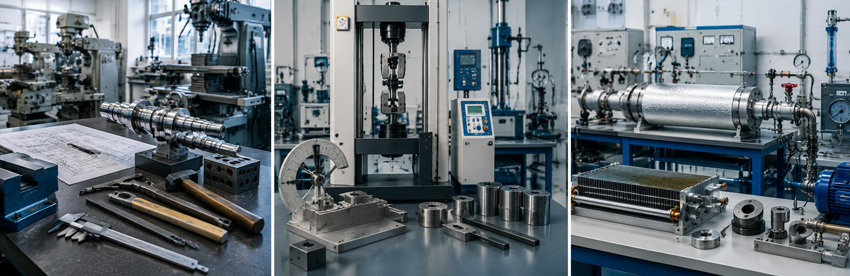
Laboratories
The Department of Mechanical Engineering houses well-established laboratories equipped with modern machines, instruments, and software to provide students with hands-on training and practical exposure. These laboratories support academic learning, research, product development, and industrial applications, enabling students to develop technical competence and problem-solving skills required in the manufacturing and engineering sectors.
Engineering Practices Laboratory
Hands-on workshop training in fitting, carpentry, welding, sheet metal, machining, and plumbing practices.
Strength of Materials Laboratory
Testing of engineering materials under tension, compression, bending, torsion, and impact loading.
Thermal Engineering Laboratory
Experiments involving IC engines, boilers, refrigeration systems, air compressors, and heat transfer equipment.
Fluid Mechanics & Machinery Laboratory
Practical experiments on pumps, turbines, flow measurement devices, and hydraulic machinery.
Manufacturing Technology Laboratory
Training in foundry, casting, turning, milling, grinding, drilling, and metal forming operations.
CAD/CAM Laboratory
Computer-aided design, simulation, CNC programming, and product development using AutoCAD, SolidWorks, CATIA, and ANSYS.
Mechatronics Laboratory
Experiments using PLCs, sensors, actuators, microcontrollers, and industrial automation systems.
Dynamics & Vibration Laboratory
Study of balancing machines, gear trains, cams, governors, and vibration analysis of mechanical systems.
These laboratories are designed to meet industry standards and provide students with practical experience in modern manufacturing, product design, automation, simulation, and quality control. The facilities encourage innovation, project-based learning, research, and the development of professional skills required for successful careers in the mechanical engineering industry.